
AI toys in China are attracting growing attention as artificial intelligence becomes increasingly integrated into consumer products. The toy industry is now one of the areas where this evolution is particularly visible.
Talking plush toys, educational robots that tell stories, and small interactive companions are appearing on the market. AI toys in China are no longer limited to adding voice features. They are also beginning to transform how consumers interact with these products.
Traditionally, the experience offered by a toy was largely defined at the time of purchase. Its appearance, features, and possible uses changed little over time.
With AI, some toys can now respond to users, remember information, and offer new content. This evolution is gradually creating a consumption model that differs from traditional toys.
An Expansion Project in China? We Can Help You!
How Are AI Toys in China Transforming the Consumer Experience?
Traditional toys can create value in different ways.
For children, entertainment and learning often go together. Collectible toys focus more on design, while licensed products rely on familiar characters.
AI adds another dimension: continuous interaction.
Thanks to voice recognition, large language models, and sensors, a toy can respond differently depending on the user. Some products can also retain information from previous interactions.
As a result, the content offered is no longer necessarily fixed.
Updates, memory, and personalized responses can change the experience after purchase. The value of the toy can therefore gradually extend beyond the physical product.
Why Are AI Toys Expanding Beyond the Children’s Market?
Toys have long been closely associated with children’s consumption. Today, AI is making this boundary less clear.
Children remain an important audience. Interactive stories, language learning, and question-and-answer features can enhance the functions of traditional educational toys.
However, new products are also targeting young adults and older consumers.
Some desktop robots focus on movement, sounds, and everyday interactions. Other products place greater emphasis on companionship and emotional experiences.
Purchase motivations are therefore becoming more diverse. Design, personal interests, social sharing, and the desire for light interaction can also play a role.
This evolution reflects the growing importance of emotional value in Chinese consumption. Toys are no longer necessarily limited to childhood. They can also become decorative or interactive objects linked to personal interests.
AI is therefore not only transforming functionality. It is also helping to expand the potential audience for AI toys in China.
Why Is Companionship Becoming Important for AI Toys?
The idea of “companionship” is appearing more frequently in discussions about toys that integrate artificial intelligence.
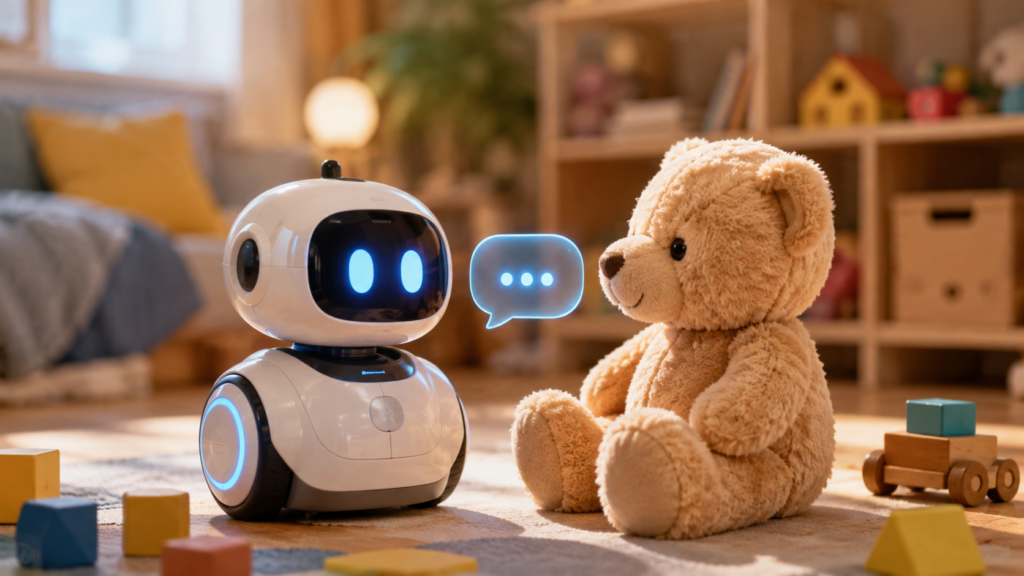
It is based on an important difference from traditional toys: the product can now respond to the user.
A traditional plush toy can already create an emotional attachment. However, this relationship largely depends on the owner’s imagination and emotional projection.
With AI, the product can respond through voice, movement, or different sounds. Memory features can also allow interactions to evolve over time.
For example, the toy can remember certain information mentioned during a previous interaction. It can then use that information to adapt future responses.
This ability gives a new dimension to the idea of companionship.
However, the ability to respond is not enough to create a lasting relationship. Interest can quickly decline if interactions become repetitive or predictable.
The key question therefore goes beyond the simple ability to talk. What matters most is whether users want to return and interact with the product regularly.
Why Is an AI Toy No Longer Limited to Hardware?
Once manufactured and sold, a traditional toy generally changes very little.
An AI toy works differently.
In addition to its physical structure, it can include chips, sensors, and a battery. Its operation may also depend on voice recognition, an AI model, or cloud services.
Part of the experience therefore continues after the purchase.
This evolution is gradually bringing some products closer to a model that combines hardware and digital services. It also raises new questions for consumers.
AI services must continue to work over time, while content may require updates. Some advanced features may also be linked to a subscription.
For products designed for children, other issues become more important. These include data protection, content safety, and screen or usage time.
The quality of the post-purchase experience is therefore becoming an important part of the product’s value.
How Is the AI Toy Market Diversifying in China?
As the range of products expands, the term “AI toy” covers increasingly different types of products.
Educational products focus on knowledge, stories, and interaction. For smart plush toys, touch, character design, and communication play a more important role.
Desktop robots tend to emphasize movement and immediate reactions. Meanwhile, some products aimed at adults place greater emphasis on design and emotional experience.
All these categories use artificial intelligence, but they do not meet the same expectations.
Parents may focus on educational value, safety, and priceYoung consumers may prioritize design, product personality, or the enjoyment of interaction.
For products focused on companionship, the ability to maintain interest over time becomes even more important.
The AI toy market in China could therefore develop around several distinct categories. Each category may gradually build its own uses, price levels, and consumer expectations.
Does AI Represent the Future of All Toys?
The current interest in smart toys does not mean that every product needs to integrate AI.
Building is part of the appeal of construction bricks. Puzzles are based on solving problems, while figurines may appeal through collecting.
A traditional plush toy can also attract consumers simply through its design and feel.
These experiences do not necessarily require artificial intelligence.
AI may therefore expand the toy market rather than replace existing products. Above all, it adds new forms of experience.
Consumers could already buy toys for their design, fictional universe, collectibility, or gameplay. Now, they can also look for interaction and personalized content.
Artificial intelligence therefore adds a new dimension to toy consumption.
Conclusion
The AI toy market in China is still in an exploratory phase. However, it already shows characteristics that differ from those of the traditional market.
From children’s education to adult uses, target audiences are becoming more diverse. Experiences are also evolving, moving from fixed functions toward more continuous interactions.
In some cases, physical products now come with digital services that continue after the purchase.
However, technology alone is not enough to create lasting demand. The experience itself and its ability to remain engaging over time are still essential.
The evolution of the market will therefore depend less on how many toys can talk and more on another question: can continuous interaction become a genuine consumer habit?
Discover STAiiRS insights to follow new consumer trends and transformations in the Chinese market.
Recent Comments