
In recent years, online commerce has continued to reshape China’s retail market. E-commerce platforms, instant retail and local delivery services are becoming increasingly connected to physical stores and nearby inventory.
For a long time, e-commerce mainly relied on large warehouses and parcel delivery. Today, however, a growing number of orders can be fulfilled directly by nearby stores or local inventory points. This development is creating new connections between digital platforms, physical retail and logistics networks.
As a result, digital retail in China is no longer limited to traditional online shopping. It increasingly combines e-commerce, local inventory, instant delivery and physical retail.
Huiyixuan illustrates this transformation. The Chinese retailer has developed a model based on instant retail and “online convenience stores,” connecting warehouses, local stores and digital platforms through a network of more than 4,000 locations across China.
An Expansion Project in China? We Can Help You!
Online Commerce Is Expanding Beyond Traditional E-commerce
According to China’s National Bureau of Statistics, online retail sales reached RMB 10.07 trillion in the first half of 2026, representing year-on-year growth of 5.2%. Online sales of physical goods reached RMB 6.43 trillion.
However, growth is not limited to transaction volumes. The way companies process and deliver online orders is also changing.
Traditional e-commerce generally follows a relatively straightforward model:
Online order → large warehouse → transportation → consumer
Instant retail works differently:
Online order → nearby inventory → local preparation → rapid delivery
The two models are not necessarily competing with each other. Instead, they respond to different consumer needs.
Traditional e-commerce remains particularly suitable for purchases that do not require immediate delivery. By contrast, instant retail relies on nearby inventory to shorten the distance between products and consumers.
Consequently, physical stores are taking on additional functions. Beyond serving customers on-site, they can store products, prepare online orders and support rapid local delivery.
Huiyixuan Develops a Network of Online Convenience Stores
Beijing Huiyixuan was founded in 2018 and opened its first store in Jinan in 2021.
The company subsequently accelerated its expansion. Its network exceeded 2,500 locations in September 2025 and reached 3,000 by the end of the year. By June 2026, Huiyixuan announced that it had surpassed 4,000 locations.
Yet Huiyixuan does not operate simply as a traditional convenience store chain. Its expansion is closely linked to China’s instant retail ecosystem.
The company has worked with Meituan Flash Delivery and Taobao Flash Delivery. It has also expanded its cooperation with JD.com in areas such as warehousing and delivery.
Its business model connects several elements:
- regional warehouses managing inventory and part of the supply chain
- local stores and storage facilities close to consumer areas
- digital tools supporting product management, replenishment and orders
- instant retail platforms generating online traffic and demand
Under this model, stores no longer depend entirely on customers walking through their doors. Digital platforms can generate orders directly and connect consumers with nearby inventory.
Physical Stores Find a New Role in Digital Retail
Location has always mattered in traditional retail. Stores close to residential neighborhoods, offices, schools or commercial districts generally benefit from stronger customer traffic.
Instant retail does not eliminate the importance of location. Instead, it gives location an additional strategic role.
For local orders, the distance between inventory and consumers directly affects delivery coverage and speed. Therefore, even stores with limited physical foot traffic can generate substantial sales through online platforms.
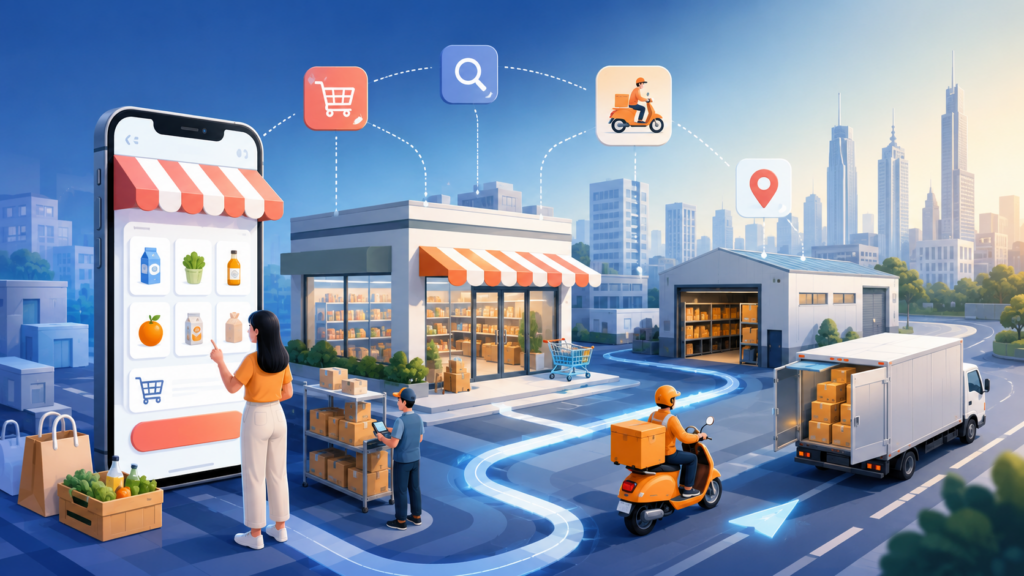
Consumers can search for a product, compare prices and place an order online. A nearby store then prepares the order, while the delivery network manages the final journey to the customer.
This creates a clearer division of roles. Platforms provide digital access to products, stores manage local inventory and order preparation, while logistics networks complete delivery.
Physical stores therefore remain important, but their role is gradually expanding within online commerce.
What Is Driving the Growth of Instant Retail?
Several factors are contributing to the expansion of instant retail in China.
First, consumer expectations are changing. For food, beverages, personal care products and everyday essentials, rapid delivery offers an additional level of convenience.
Second, platforms continue to invest heavily in local commerce. Meituan, Taobao and JD.com are strengthening the connections between merchants, inventory and delivery networks.
Meanwhile, improvements in the supply chain allow retailers to manage local stock more efficiently and respond more quickly to demand.
The customer experience therefore depends on several interconnected factors. Consumers need to find the right product, confirm its availability, compare prices and receive it within an acceptable delivery time.
For retailers, platform visibility, inventory management, logistics and delivery are consequently becoming much more closely connected.
Different Retail Models Continue to Coexist
Huiyixuan represents only one of the models emerging within China’s changing retail landscape.
Traditional convenience stores continue to rely heavily on physical location, in-store experience and local customers. Other retailers increasingly process orders generated through instant retail platforms.
At the same time, companies such as Hema and Xiaoxiang Supermarket are developing models that combine physical stores, mobile applications, loyalty programs, private-label products, supply chains and rapid delivery.
These models serve different consumer needs and business objectives. Nevertheless, they all demonstrate the growing connection between digital demand and physical retail infrastructure.
A physical store can now process an e-commerce order. Likewise, an online platform can redirect consumer demand toward nearby inventory. Some warehouses can even prepare and dispatch orders directly to local customers.
Therefore, digital retail in China increasingly depends on coordination between online and offline channels rather than on a single distribution model.
Consumer Shopping Habits Are Also Changing
The transformation of retail is closely connected to changing consumer behavior.
In China’s digital ecosystem, the different stages of the purchasing journey increasingly overlap.
Consumers may discover a product through Xiaohongshu or Douyin. They can then search for additional information, compare user experiences and read reviews before making a purchase.
The final transaction may take place through an e-commerce marketplace, an official brand channel or an instant retail platform.
This means that omnichannel retail is not simply about being present across multiple platforms. Brands also need to understand the role each channel plays in the consumer journey.
Content can generate awareness and interest. Search helps consumers gather information. E-commerce platforms facilitate transactions, while logistics ensures that the product reaches the customer.
When these elements work together effectively, consumers experience a smoother path from product discovery to purchase.
What Does Online Commerce Mean for International Brands?
For international companies, the evolution of online commerce means that entering China’s digital market involves more than choosing an e-commerce platform.
Product availability, local distribution, inventory management and delivery capabilities are becoming equally important.
Brands need to understand not only where consumers discover their products, but also how easily those products can be found and purchased.
This requires a broader view of digital retail in China.
Search engines, social media, e-commerce marketplaces, physical stores, local inventory and logistics increasingly form part of the same commercial ecosystem.
For international brands, coordinating these different channels can help create a more consistent consumer experience and support long-term development in the Chinese market.
New Connections Are Reshaping Chinese Retail
The development of Huiyixuan, Hema and Xiaoxiang Supermarket illustrates how China’s retail market is building stronger connections between platforms, stores, inventory and delivery.
In this environment, online commerce is no longer limited to transactions completed through traditional e-commerce platforms.
Instead, content, search, physical retail, the supply chain and local logistics increasingly interact throughout the consumer journey.
For international brands, the challenge is therefore not simply to select the right sales channel. They also need to understand how different platforms, retail formats and distribution networks work together in China.
STAiiRS helps international brands improve their visibility in China through search engines, social media, AI platforms and localized content strategies.
Want to better understand online commerce and digital retail in China? Contact STAiiRS to explore the right strategy for your brand.
Recent Comments