
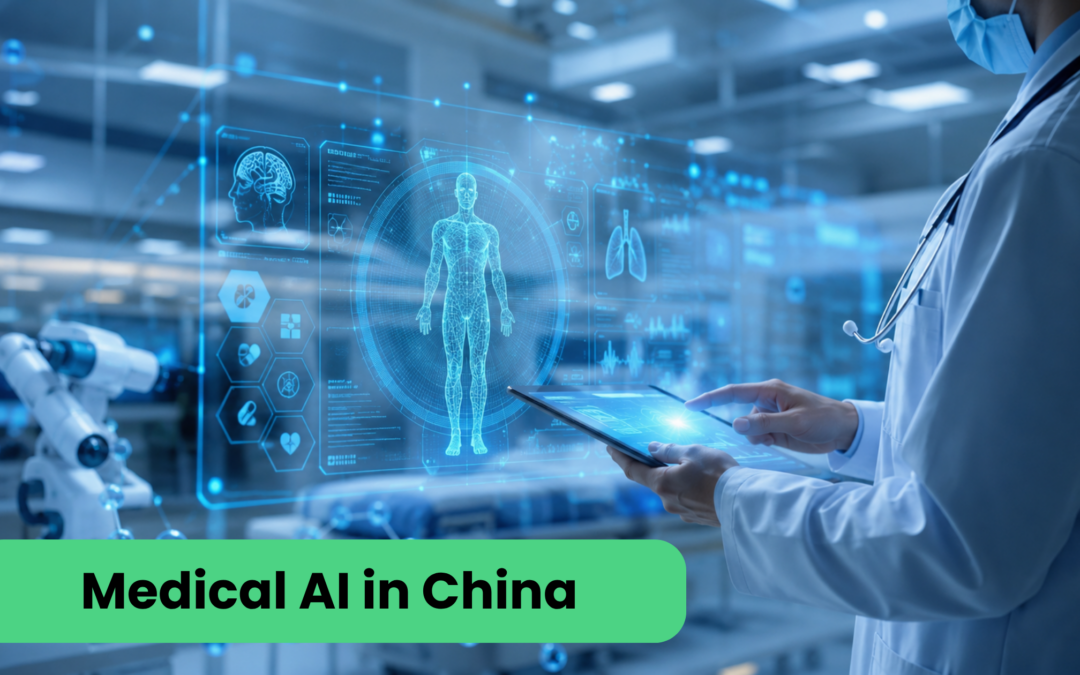
Over the past few years, Medical AI has become one of the fastest-growing fields in China’s technology industry. From virtual doctors and AI-assisted diagnosis to smart hospitals and pharmaceutical research, innovation continues to accelerate.
Meanwhile, expectations across the healthcare sector are changing. Market players are no longer focused solely on digitalising existing services. Instead, they are exploring how artificial intelligence can improve the overall efficiency of healthcare systems.
As a result, Medical AI in China is becoming an increasingly strategic area for many technology companies.
An Expansion Project in China? We Can Help You!
AI Is Reshaping the Healthcare Sector
For several years, technology companies have invested heavily in digital health. Consequently, many online healthcare services have emerged to improve access to medical care.
Thanks to this first wave of digital transformation, patients now benefit from smoother healthcare journeys and more accessible services.
However, the arrival of artificial intelligence marks a new stage.
Companies are no longer focused only on digitalising healthcare services. They are also working to improve the quality, speed, and efficiency of medical care.
As a result, AI is gradually being adopted across diagnosis, patient management, medical data processing, and pharmaceutical research.
Why Are Companies Taking Different Approaches?
Although almost every major technology company is investing in Medical AI, their strategies are far from identical.
Some companies aim to build complete healthcare ecosystems by combining health content, online consultations, AI tools, and offline medical services. Their goal is to support patients throughout the entire healthcare journey.
Others prefer a more open strategy by providing AI solutions for hospitals, doctors, and pharmaceutical companies to improve operational efficiency.
Meanwhile, some businesses are gradually integrating artificial intelligence into their online healthcare and pharmacy services.
Ultimately, these different approaches reflect each company’s own resources, expertise, and long-term priorities.
How Is Medical AI Different from Traditional Digital Health?
Over the past decade, digital health has mainly improved connections between patients and healthcare providers.
Online appointments, digital payments, and remote consultations have made healthcare services easier to access. However, these solutions have not fully addressed the shortage of medical resources.
This is precisely why Medical AI is attracting so much attention.
Unlike earlier digital platforms, AI does more than connect different parts of the healthcare system. It also helps strengthen medical capabilities.
For example, intelligent triage systems, medical report analysis, and AI-assisted diagnosis already automate certain tasks while supporting healthcare professionals in their daily work.
Consequently, today’s transformation is no longer limited to improving information exchange. It also focuses on enhancing healthcare services and increasing the overall efficiency of the medical system.
Medical AI in China Enters a New Stage
Today, Medical AI in China is entering a new phase of development.
Technology companies are no longer focused solely on launching new AI products. Instead, they are integrating artificial intelligence into the everyday work of hospitals, doctors, and patients.
At the same time, several important challenges remain.
Data security, model reliability, medical responsibility, and system interoperability continue to be key issues across the healthcare industry.
Nevertheless, the market’s direction is becoming increasingly clear. The objective is no longer simply to connect healthcare providers. Instead, companies aim to improve the healthcare system’s ability to meet growing demand.
Understanding the Evolution of China’s Healthcare Market
STAiiRS continuously monitors Medical AI, Medical AI in China, and medical innovation to help international companies better understand developments in China’s healthcare market.
As artificial intelligence becomes increasingly integrated into medical practice, China is emerging as one of the world’s most active healthcare technology markets.
For businesses interested in digital health and medical technologies, understanding these developments will be essential to identifying future opportunities.
Recent Comments